
The coat of arms and the anthem are what Estonia shows the world at its most solemn moments. Behind each of them lie centuries of history and the struggle for the right to be oneself.
Coat of arms · National anthem
National coat of arms
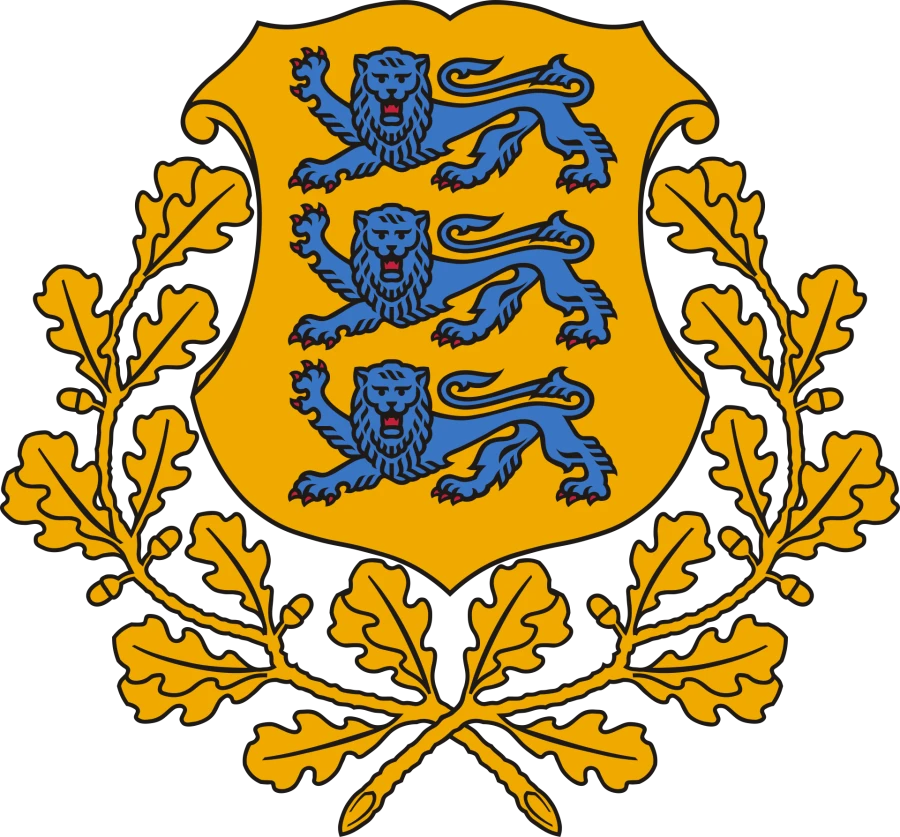
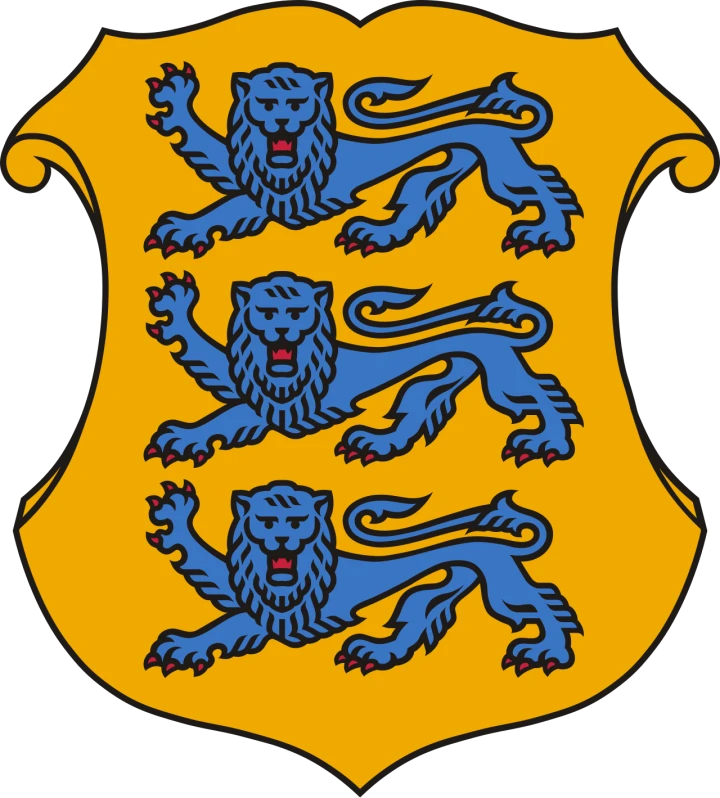
Three blue lions walk across a golden shield, their gaze turned towards the viewer.
Estonia’s national coat of arms has two forms: the greater and the lesser. On the greater coat of arms the shield is surrounded by a wreath of two crossed golden oak branches that meet at the bottom. The lesser coat of arms is identical but without the oak branches.
Where the three lions come from
The motif of three lions goes back to the 13th century and is associated with the Danish king Valdemar II, in whose time Tallinn received such an emblem. Later the three lions became a symbol of the whole of Estonia.
The Riigikogu adopted it as the coat of arms of independent Estonia on 19 June 1925. It was banned during the Soviet occupation and restored on 7 August 1990.
The oak branches of the greater arms are traditionally linked with strength and endurance.
National anthem
Estonia’s anthem is called “Mu isamaa, mu õnn ja rõõm” (“My fatherland, my happiness and joy”).
The melody was composed by Fredrik Pacius, a German-born composer who worked in Finland. The same melody is also the Finnish national anthem. The Estonian words were written by Johann Voldemar Jannsen, a figure of the national awakening and the founder of the newspaper Postimees.
The song was first performed in Tartu in June 1869 at the first all-Estonian Song Festival. It became the anthem of independent Estonia in 1920. Performing it was forbidden in Soviet times: from 1945 the anthem of the Estonian SSR was used. In 1990 “Mu isamaa, mu õnn ja rõõm” became the national anthem again.
Listen to the anthem
English translation
My native land, my joy and delight,
how beautiful you are!
I shall never find
in all this great, wide world
anything as dear to me
as you, my native land!
It was you who gave me birth
and raised me up,
I shall always give you thanks
and stay true to you until death,
to me you are the dearest of all,
my precious native land!
May God watch over you,
my beloved native land!
May He be your protector
and richly bless
whatever you undertake,
my precious native land!
Estonian (original)
Mu isamaa, mu õnn ja rõõm,
kui kaunis oled sa!
Ei leia mina iial teal
see suure, laia ilma peal,
mis mul nii armas oleks ka,
kui sa, mu isamaa!
Sa oled mind ju sünnitand
ja üles kasvatand,
sind tänan mina alati
ja jään sull' truuiks surmani,
mul kõige armsam oled sa,
mu kallis isamaa!
Su üle Jumal valvaku,
mu armas isamaa!
Ta olgu sinu kaitseja
ja võtku rohkest õnnista,
mis iial ette võtad sa,
mu kallis isamaa!
Based on publicly available reference sources about Estonia’s national symbols. If you notice an inaccuracy, please write to us.